REVIEW · VANCOUVER
Ancient Trees of Vancouver Walking Tour
Book on Viator →Operated by Ancient Trees of Vancouver · Bookable on Viator
Stanley Park hides time travelers among trees. This 3-hour Ancient Trees of Vancouver walk in Stanley Park uses easy park trails to spotlight old-growth giants and the stories around them, led by big-tree specialist Colin Spratt.
I love two things right away: the specific, named trees you’ll learn to recognize, including centuries-old Douglas firs and ancient cedars, plus the largest known maple in Canada; and the way the tour uses old maps and postcard-style archive images to make the history feel real, not textbook.
One practical consideration: there’s no pick-up, so you’ll need to make your own way to the meeting point at Ferguson Point.
In This Review
- Key highlights you’ll feel during the walk
- Why this Stanley Park tree tour is different from the usual stroll
- Starting at Ferguson Point: what timing and pace really mean
- The ancient trees you’ll learn to spot (Douglas firs, cedars, and the big maple)
- Old maps and 120-year postcards: turning Stanley Park history into a story you can follow
- What old-growth forests do for an ecosystem (and why it’s at risk)
- Conservation lessons you can take home after three hours
- Small group means more questions, more detail, and a better walk
- How much value you get from the $56.33 price
- Who should book this tour (and who might choose something else)
- Should you book Ancient Trees of Vancouver?
- FAQ
- Where do I meet for the Ancient Trees of Vancouver Walking Tour?
- How long is the walking tour?
- What is the group size limit?
- Is the tour offered only in the morning?
- Is pick-up or drop-off included?
- What language is the tour in?
- Is there a ticket price for Stanley Park included?
- How much does the tour cost?
- What’s the cancellation window?
Key highlights you’ll feel during the walk
- Max 10 participants keeps the pace calm and the questions from getting swallowed.
- Colin Spratt’s big-tree focus turns you from tree admirer into tree spotter.
- Old maps, photos, and 120-year postcards bring Stanley Park history to life.
- Ancient specimens on easy trails means you’re not forced into a hard hike to see wonders.
- Ecology lessons you can use later (like how old forests regenerate) make the whole park click.
- Flexible morning or afternoon tours help you fit this into a busy Vancouver plan.
Why this Stanley Park tree tour is different from the usual stroll
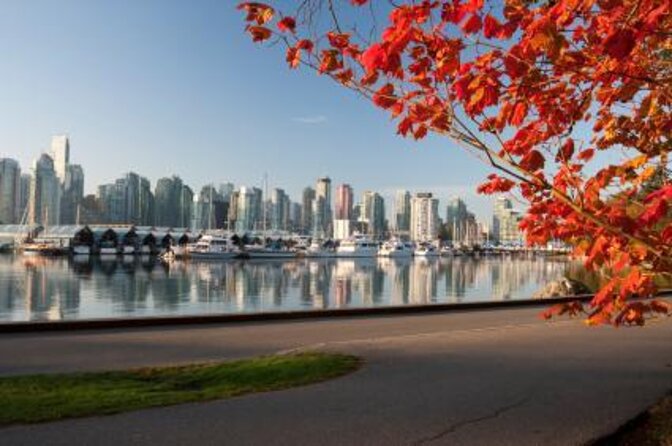
Stanley Park can feel like a single big “nature box” in your mind. This tour helps you see the details instead. You’re not just walking for views. You’re walking with a guide who treats trees like living history you can read.
I like the format because it’s small-group and story-led. With up to 10 people, you get room to ask questions and actually hear the answers. And because the focus stays on the forest, it’s a refreshing break from the usual Vancouver checklist.
The second thing that makes this work is the mix of hands-on observation and human history. You’ll look at the shapes, the growth patterns, and the age clues. Then you’ll hear how people have understood and used these trees for a very long time.
You can also read our reviews of more walking tours in Vancouver


Starting at Ferguson Point: what timing and pace really mean
You meet at Ferguson Point, 7501 Stanley Park Dr. The tour ends back at the meeting spot, so you’re not stuck trying to navigate a self-planned loop after the walk.
The duration is about 3 hours, which is long enough to feel like a true experience, but short enough that it won’t steamroll your afternoon or morning. In practice, that means you can pair it with breakfast plans or a later dinner without sweating your schedule too much.
One more thing I appreciate: the tour is offered in morning and afternoon slots. If you’re visiting in summer and the park is busy, you’ll have more chances to pick a time that feels comfortable.
The ancient trees you’ll learn to spot (Douglas firs, cedars, and the big maple)
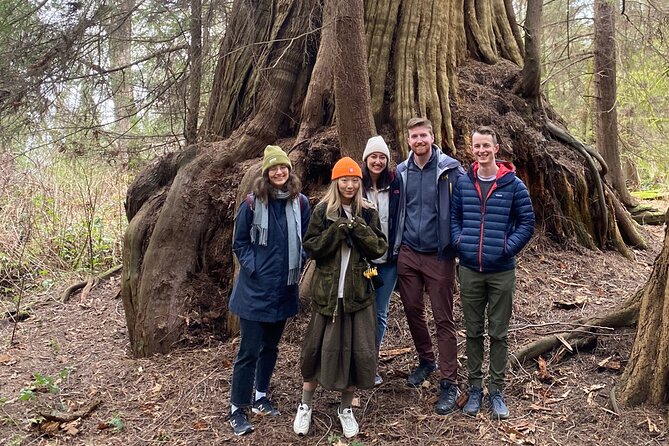
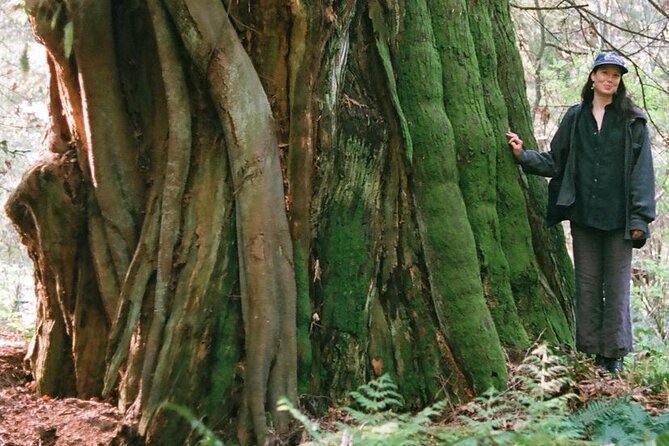
This walk centers on the best tree “stars” in Stanley Park, the kind of specimens you don’t notice unless someone teaches your eyes where to look.
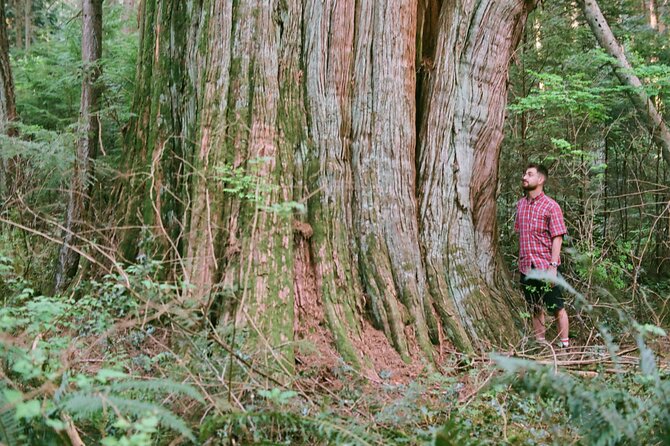
Colin highlights trees that can be hundreds to around a thousand years old, including towering Douglas firs that are described as about 600 years old, and cedars that can reach around 800 to 1,000 years. You’ll also hear about the largest known maple tree in all of Canada.
What I like about this approach is that it changes how you look at the park after the tour. A lot of people go to Stanley Park and think they’ve seen trees. After this, you’ll realize there’s a whole second layer: structure, age, habitat details, and the way different species share space.
You’ll also get real-world context for why age matters. Old trees aren’t just “old.” They’re bigger habitat systems, with hollows, layered life, and lots going on at once. Reviews also point to the chance to see trees with hollows that can serve as homes for wildlife, including bears, which makes the forest feel less like scenery and more like a functioning neighborhood.
Old maps and 120-year postcards: turning Stanley Park history into a story you can follow
One reason people leave this tour talking is that it doesn’t treat history as a lecture. It uses visuals—old maps, photographs, and about 120-year-old postcards—to connect what you’re standing near to what used to be there.
As you walk, those archive images help you build a timeline. You learn how Stanley Park became an urban park, and you get the broader context of the land before that—especially the Coast Salish presence, with the reminder that this area was home to Indigenous communities for thousands of years.
I find this method much more memorable than dates-only history. When you’re physically in the woods and you’re holding an image of how it looked earlier, it’s easier to understand what has changed and what has survived.
And because the tour is guided by someone who’s clearly passionate, the story stays lively. The point isn’t just to know facts. It’s to understand why these trees mattered before cars and condos—and why they still matter now.
What old-growth forests do for an ecosystem (and why it’s at risk)
This tour’s “why it matters” section is one of the strongest parts. You’ll hear about the ecological importance of old-growth forests and the threats these areas face today.
In plain terms, old-growth forest isn’t just older trees. It supports:
- complex habitats,
- richer life cycles,
- and slower, steadier processes that younger forests can’t replicate in the same way.
Colin’s explanations (based on what many people highlight) often include the kind of details that make you see the forest as a living system. For example, you may learn about concepts like nurse logs, where fallen trees help new life get established. That connects directly to what you’re seeing on the ground, not just what’s “out there in theory.”
You’ll also hear about how old trees can reproduce and persist in layered ways—sometimes with multiple generations living together. That can be startling in a city park. It’s a reminder that the forest didn’t just survive by luck. It survived because the conditions, protection, and ecological mechanics are still functioning.




Conservation lessons you can take home after three hours
By the end of the walk, you don’t just feel impressed. You understand why you should care—and what “care” actually looks like.
The tour frames conservation as more than saving trees in a vague, feel-good way. It connects the dots between:
- how old trees protect habitat,
- how they regenerate,
- and what modern pressures can interrupt.
You may also hear cultural and practical uses of cedar that connect ecology to everyday life. Several reviews mention stories about cedar as a “tree of life,” including how fibers were used in textiles and how cedar supported tools and structures like longhouses and canoes. You might even hear about the bark’s role for clothing and rope, and the careful ways Indigenous communities interacted with trees.
Even if you’re not coming to learn Indigenous history as your main goal, this part lands because it’s relevant to the tree itself. It’s not just “cedar is important,” it’s why it was important, how it was used, and what that says about long-term thinking.
Small group means more questions, more detail, and a better walk
The maximum of 10 travelers is not just a comfort feature. It affects your learning.
When you’re in a crowd, guides tend to rush. Here, people highlight that Colin’s delivery gives room for curiosity. Families in particular mention that he stays patient and engaged with kids, which helps explain why adults feel comfortable asking their own questions too.
If you’re the type who likes to understand what you’re seeing—rather than just taking photos—this group size matters. It keeps the tour from turning into a rapid line-walk where you catch only half the story.
Also, the tour is built around walking trails that are described as easy enough for most visitors. That makes it a great option if you want something meaningful that doesn’t require a whole day of hiking stamina.
How much value you get from the $56.33 price
At about $56.33 per person, this isn’t a bargain excursion. But it also isn’t overpriced for what you’re getting.
Here’s why the value feels strong:
- You’re paying for an expert guide who focuses on big trees, including Colin Spratt’s experience as a big tree seeker and BC Big Tree Committee member.
- You’re seeing standout ancient specimens in Stanley Park in a short time.
- You get story support with archive materials like old maps and postcards, which most standard walks don’t provide.
- Park admission is shown as free for this experience, so you’re not stacking extra entry fees on top.
If your goal is to understand Stanley Park beyond the obvious photo spots, the price makes more sense. This tour is basically a shortcut to deeper insight.
If, however, you just want a quiet walk and you’re the type who’s happy reading one or two signs on your own, you might feel this is too guided for your taste. But even then, it can still be worth it because you’re not just learning history. You’re learning how to notice trees.
Who should book this tour (and who might choose something else)
This is a strong fit if you:
- love forests, trees, or ecology,
- enjoy history that’s connected to real places,
- want a small-group experience instead of a crowded “walk and move on,”
- and like guides who tell stories with a clear purpose.
It’s also a good choice for families, including kids around early school age, since people highlight that Colin handles questions well and keeps kids engaged.
If you’re looking for a high-energy sightseeing loop with lots of different neighborhoods, you might prefer a broader city tour. This one stays focused on Stanley Park and its ancient tree story. That focus is the strength, but it’s also the trade-off.
Should you book Ancient Trees of Vancouver?
Yes, if you want Stanley Park to feel deeper than it looks from the seawall. This tour is one of those rare experiences where you leave with a new way of seeing the same trees you would have walked past on your own.
I’d book it when you have about half a morning or afternoon to spare, and when you want to slow down and learn. With a maximum of 10 people and a guide like Colin Spratt, it’s the kind of small investment that pays back in curiosity for the rest of your trip.
If you tell me your travel dates and whether you prefer morning or afternoon, I can help you decide the best time to fit this into your day around other Vancouver must-dos.
FAQ
Where do I meet for the Ancient Trees of Vancouver Walking Tour?
The tour meets at Ferguson Point, 7501 Stanley Park Dr, Vancouver, BC V6G 3E2, Canada.
How long is the walking tour?
The tour lasts about 3 hours.
What is the group size limit?
This tour has a maximum of 10 travelers.
Is the tour offered only in the morning?
No. It is offered in both morning and afternoon tours for flexibility.
Is pick-up or drop-off included?
No pick-up and drop-off is included. You’ll need to get to the meeting point on your own.
What language is the tour in?
The tour is offered in English.
Is there a ticket price for Stanley Park included?
The experience is marked as having Admission Ticket Free.
How much does the tour cost?
The price is $56.33 per person.
What’s the cancellation window?
You can cancel up to 24 hours in advance for a full refund.